
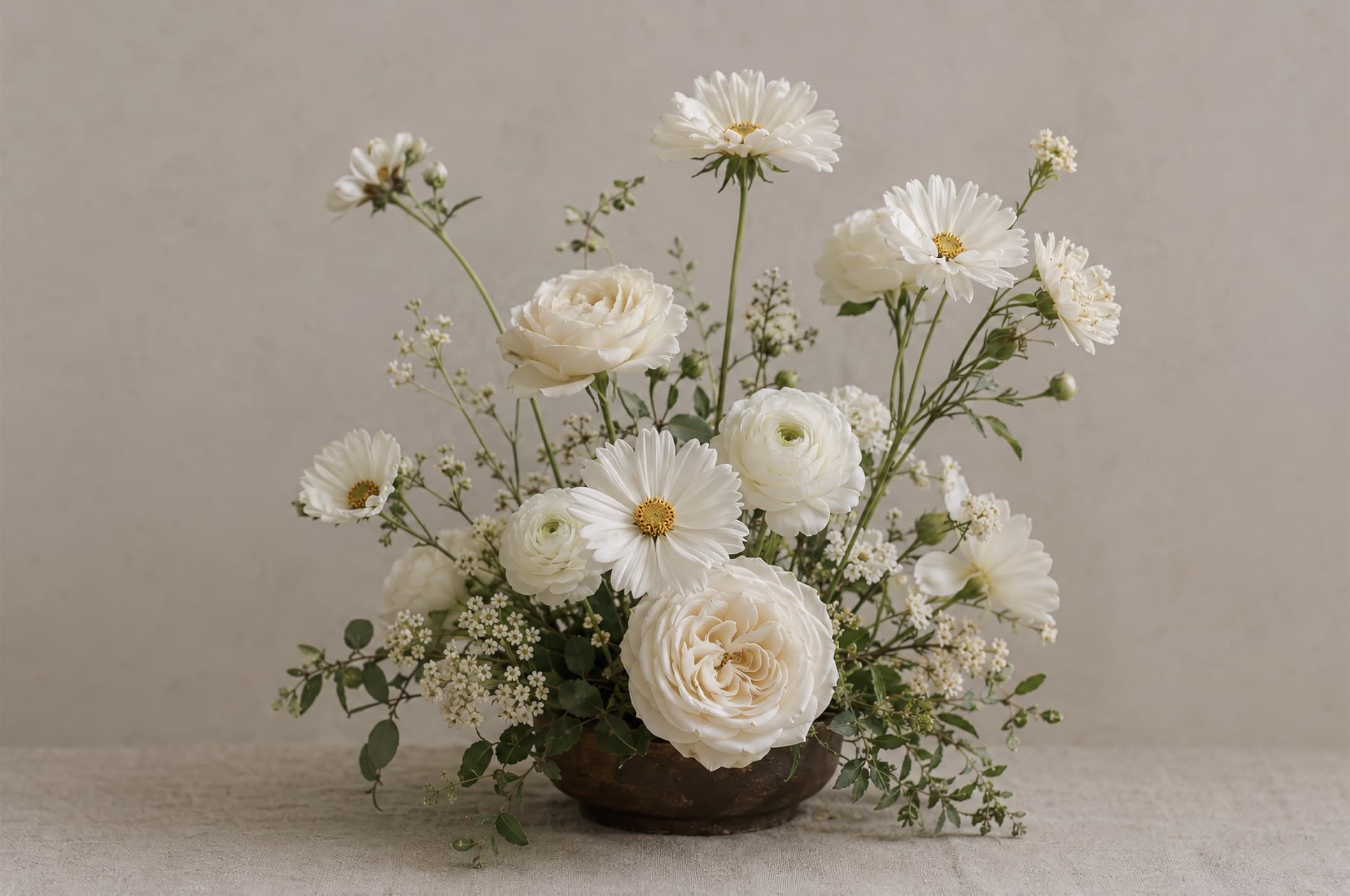
Choosing flowers for someone who is grieving is never easy. There is often so much you want to say, and so few words that feel like enough. At Hana Studio, we believe flowers can help carry those feelings — the care, the sympathy, and the quiet thinking-of-you that is hard to put into words. This guide is here to make the choice a little gentler.
For most funerals and celebrations of life in Greater Vancouver, a white-and-green arrangement is the safe, respectful choice — think lilies, white roses, chrysanthemums, hydrangeas, or orchids. Keep the palette restrained rather than bright. If you are unsure what suits a family’s culture or faith, tell us what you know when you order and we will guide you.
How We Help You Choose
Sympathy orders are personal, so we start by understanding a few things: who the flowers are for, what you hope to express, and whether there are any religious or cultural considerations we should honour. From there, we help you choose the flowers and colours that feel right. Our goal is simple — to help your flowers say the things that are difficult to speak aloud.
If you would like to talk it through, you are always welcome to get in touch. Sometimes it helps to reach a real person during a hard week, and a short conversation often settles the choice faster than scrolling a website.
Types of Sympathy Arrangements — and Who Usually Sends Each
Sympathy flowers come in several traditional forms, and which one suits you depends on how close you were to the family and where the flowers are going. Here is a plain-language guide to the most common types, so you can choose with confidence.
Sympathy Bouquets and Vase Arrangements
A hand-tied bouquet or a vase arrangement is the gentlest, most personal choice, and the one most people send. It is ideal for delivery to the family home, where a ready-to-display vase means no one has to hunt for something to put the flowers in during an already difficult week. This is the right choice for friends, extended family, colleagues, and neighbours.
Standing Sprays and Easel Arrangements
A standing spray is a larger, one-sided arrangement displayed on an easel at the funeral or celebration of life. Because of its size and presence, it is usually sent by close family, a group of colleagues, or an organisation, and it is meant for the service venue rather than the home. If you are contributing to a shared arrangement from an office or a circle of friends, this is often the form it takes.
Wreaths
A wreath, with its unbroken circle, is a traditional symbol of eternal life and remembrance. Like a standing spray, it is a statement piece intended for the service, and is commonly sent by family or a close group. Wreaths suit more formal or traditional services.
Casket Sprays
A casket spray is the arrangement that rests on the casket itself. This is traditionally chosen and paid for by the immediate family — a spouse, children, or parents — so unless you are part of that inner circle, it is not something you would usually send. We mention it here mainly so you know what it is if the family asks us to help with one.
Sympathy Plants — Orchids and Peace Lilies
A living plant, such as an orchid or a peace lily, is a quietly meaningful choice because it lasts. Long after the service, the family still has something growing to tend and remember by. Plants are especially thoughtful when sent to the home, and they suit people who would appreciate a lasting keepsake rather than cut flowers.
Sympathy Baskets
A low basket arrangement is easy to place on a table or shelf and needs no vase, which makes it practical for both the home and the service. It is a warm, unfussy option when you want to send something substantial without the formality of a spray or wreath.
What Flowers to Send
Certain blooms have long been associated with remembrance and peace. Any of these can be arranged on their own or combined into a soft, dignified bouquet or arrangement:
- Lilies — a classic symbol of peace and the restored innocence of the soul; the white lily is the most traditional funeral flower in North America
- White roses — reverence, honour, and enduring love
- Chrysanthemums — in Chinese and many East Asian cultures, the flower most associated with mourning and remembrance
- Hydrangeas — heartfelt, gentle, and understated; a soft way to fill an arrangement
- Orchids — a graceful, lasting plant that the family can keep long after the service
A few flowers are best avoided unless you know the family would welcome them: very bright, celebratory colours (hot pink, bright orange) can feel out of step with a solemn occasion, and red roses specifically read as romantic love rather than sympathy.
Choosing Based on Your Relationship to the Family
If you were very close to the person who died — family, a partner, a lifelong friend — you have the most freedom to be personal. You might choose their favourite flower, or a colour that meant something to them, and a slightly larger or more considered arrangement is appropriate. This is also the moment where a heartfelt, specific card message matters most.
For a friend, or a friend of the family, a classic white-and-green bouquet or a vase arrangement sent to the home is always right. You do not need anything grand — warmth and simplicity carry the message.
When you are sending on behalf of an office, a team, or a group of friends, a single larger arrangement signed from everyone often feels more meaningful, and more manageable, than many small ones. Let us know it is a group gift and we will make sure the card reflects that. A standing spray or a generous vase arrangement works well for this.
Sending to the Home or to the Service
Flowers sent to the family home are a private comfort, received in the days around the service when the household is quietest. A vase arrangement or a plant is ideal here, because it arrives ready to place and asks nothing of the family. If you know the family well, the home is often the kinder destination.
Flowers sent to a funeral home or a celebration-of-life venue are part of the service itself, and timing matters. If you are sending to a service, it helps us to know the venue name, the date and time of the service, and the name of the family or the person who has died, so the card is addressed correctly and the flowers arrive before guests do. When you are unsure of these details, get in touch and we will help you work them out.
What to Write on the Sympathy Card
The card is often the hardest part. There is no perfect sentence, and you do not need one — a few sincere words mean more than anything elaborate. If it helps, here are some gentle wordings you are welcome to borrow or adapt:
- "Thinking of you and your family during this difficult time."
- "With heartfelt sympathy. [Name] will be dearly missed."
- "Holding you close in our thoughts, with love."
- "There are no words for a loss like this. We are so sorry."
- "With deepest condolences from all of us at [your team or office]."
- "Remembering [Name] with so much love — always in our hearts."
A few gentle things to keep in mind: it is kindest to keep the message short and sincere, to avoid phrases that begin with "at least", and to be careful with religious wording unless you know the family shares that faith. If you would rather we suggested something for your specific situation, just ask when you order and we will help you find the words.
Honouring Cultural Traditions
Greater Vancouver is one of the most multicultural regions in Canada, and sympathy customs vary a great deal from family to family. We are glad to help Chinese and other Asian families, and we understand that these arrangements often call for white and green tones, a restrained palette rather than bright colours, and above all a sense of respect and solemnity.
Because customs vary so much, the guidance below is a gentle starting point rather than a rule book. When you are unsure, the kindest thing is simply to tell us what you know about the family, and let us help.
- Chinese and many East Asian families — white and yellow chrysanthemums, white lilies, and restrained white-and-green arrangements are traditional. Red is avoided at funerals, as it signifies joy and celebration.
- Buddhist services — simple, white arrangements are welcomed; modest and understated is the spirit.
- Christian and Catholic services — flowers are widely accepted, from bouquets to standing sprays and wreaths, sent to either the home or the service.
- Jewish funerals and shiva — flowers are not part of the tradition. A charitable donation in the person’s memory, or food sent to the family during shiva, is the customary and more welcome gesture.
- Muslim funerals — simplicity is valued and flowers are not central. Many families appreciate a donation or a quiet expression of sympathy instead; if you would like to send flowers, it is best to ask the family first.
- Hindu and Sikh services — flowers and garlands are often used, usually in white, though customs and timing vary; when in doubt, ask, as services frequently happen very soon after a death.
If any of this feels uncertain, that is completely normal. Tell us what you know about the family and their faith, and we will make sure what you send is respectful — or gently suggest a more fitting alternative.
Where and When We Deliver
We deliver sympathy flowers across the Greater Vancouver area, including Vancouver, Burnaby, Richmond, Surrey, Langley, and Coquitlam. Arrangements can be sent to a family home, a funeral home, or a celebration-of-life venue.
Funeral timing can be tight, and we understand you may only have a day or two of notice. Where possible we will do our best to accommodate an urgent request — the fastest way to arrange this is to reach us so we can confirm timing before you order. For flowers going to a service, it helps to have the venue name, the service date and time, and the family or deceased’s name for the card.
Frequently Asked Questions
What flowers are appropriate for a funeral in Vancouver?+
Lilies, white roses, chrysanthemums, hydrangeas, and orchids are all fitting. White and green arrangements read as calm and respectful and suit most services. Avoid very bright colours and red roses unless you know the family would welcome them. A few traditions — including Jewish and Muslim funerals — often prefer donations or simplicity over flowers, so if you know the family’s faith, tell us and we will advise.
Can you deliver sympathy flowers to a funeral home in Vancouver?+
Yes. We deliver across Greater Vancouver — to funeral homes, celebration-of-life venues, or a family home. When time allows we will do our best to accommodate urgent, same-week requests. Get in touch so we can confirm timing and the venue details with you.
What flowers should I avoid for a Chinese funeral?+
Avoid red, which signifies joy and celebration in Chinese culture. White and yellow chrysanthemums, white lilies, and white or green arrangements are the traditional, respectful choices. If you are unsure, tell us and we will guide you.
How much notice do you need for sympathy flowers?+
A day or two is ideal, but funeral timing is often short. Reach out as soon as you can and we will do our best to arrange something appropriate in time.
Can I add a message to sympathy flowers?+
Absolutely. We hand-write your message on a Hana Studio card. If you are unsure what to write, we are happy to suggest a few gentle wordings.
Should I send flowers to the home or the funeral home?+
Both are appropriate. A vase arrangement or a plant sent to the family home is a private, lasting comfort, while flowers sent to the service are present on the day. If you send to a service, give us the venue name, date, and time so they arrive before guests.
What should I write on a sympathy card?+
Keep it short and sincere — something like "Thinking of you and your family during this difficult time" is always enough. Avoid phrases that begin with "at least", and if you are unsure, we are glad to suggest a wording for your situation.
Is it appropriate to send flowers for a Jewish or Muslim funeral?+
Often not in the way you might expect. Jewish tradition usually favours a charitable donation, or food sent to the family during shiva, rather than flowers, and Muslim funerals lean toward simplicity. If you know the family’s faith, tell us and we will guide you toward the most respectful gesture.