
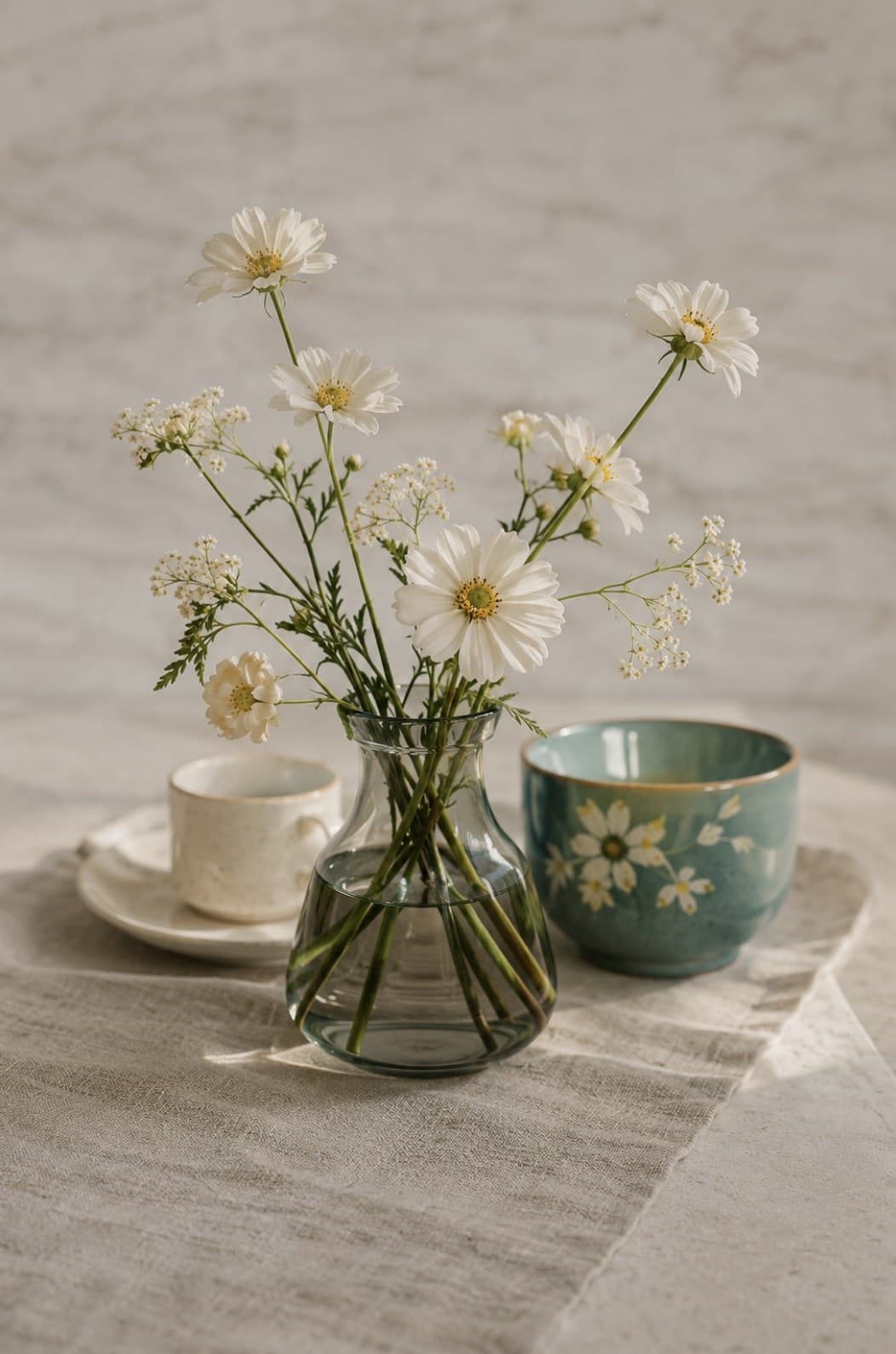
One idea sits at the heart of everything we make at Hana Studio: flowers do not need to be many to be powerful. A single stem, given room to breathe, can say more than an armful. This quiet, intentional approach is deeply influenced by Japanese aesthetics — and it shapes the way we design, the way we choose each flower, and the way we hope you feel when you live alongside the finished piece.
Hana Studio creates Japanese-inspired floral design in Vancouver — minimal, natural arrangements shaped by negative space, line, and the seasons. Our founder is self-taught, drawing on a love of Japanese aesthetics and ikebana principles rather than a formal ikebana school. We also run floral classes, including a Mindfulness Through Flowers session.
What Is Japanese-Inspired Floral Design?
Japanese floral art — most famously ikebana, the traditional art of flower arrangement — is built on ideas quite different from a full, symmetrical Western bouquet. Instead of mass and abundance, it values line, form, and the empty space around each stem (a concept the Japanese call "ma"). Arrangements tend to be asymmetric, seasonal, and pared back, so that a few carefully placed elements can carry the whole design.
Japanese-inspired design takes those principles — negative space, natural line, restraint, and a deep respect for the season — and interprets them in a modern, wearable way. It is less about strict rules and more about a feeling: calm, natural, and intentional. There is no foam pillar hidden inside, no need to fill every gap; the design invites your eye to rest as much as to look. That is the spirit behind our work at Hana Studio.
Japanese-Inspired vs Western Floral Design
It helps to see this style beside the fuller, rounded bouquet many of us picture when we think of flowers. Neither approach is better than the other — they simply come from different instincts about what a flower is for. A classic Western arrangement is generous and celebratory, built to fill a space with colour. A Japanese-inspired arrangement is quieter and more selective, built to frame a single gesture and let the space around it do part of the work. Understanding the contrast makes it easier to know which you are drawn to, and to ask for it by name.
- Western design leans on mass, abundance, and symmetry; Japanese-inspired design leans on line, negative space, and asymmetry.
- A Western bouquet often uses many blooms packed closely together; a Japanese-inspired piece uses fewer, intentional stems with room between them.
- Western arrangements frequently rely on hidden mechanics — floral foam, tape, and wire tucked out of sight; Japanese-inspired work lets the natural structure show, and traditionally holds stems with a kenzan (a spiked pin holder) so each line stands exactly where it is placed.
- A florist working in the Western tradition can build a similar look year-round from imported stock; Japanese-inspired design follows strict seasonality, so the arrangement changes as the year does and never pretends it is a different month.
- Western design tends to hide the vessel inside the flowers; here the vessel is part of the composition, chosen to be seen and to hold its own quiet share of the balance.
A Self-Taught Journey, Rooted in Japanese Aesthetics
Our founder did not come to floristry through a formal school. The journey began in a working flower shop — conditioning stems, caring for fresh flowers, wrapping bouquets, and building floral gifts day after day — and has continued through workshops with many different teachers ever since. Floristry, for us, is a path of continuous learning, and every new season and every new flower is a chance to grow.
Alongside that hands-on experience is a long love of Japanese culture. Japanese floral art revealed something we keep coming back to: that restraint, negative space, and line can be more moving than abundance. Our work is inspired by these principles — interpreted in a modern, natural style — rather than practised as a formal school of ikebana. We say that plainly because it matters: we honour the tradition by naming it as the inspiration it is, not a certification we hold.
The Principles Behind Our Work
- Negative space — the empty room around a stem is part of the design, not an absence
- Line and movement — we follow the natural gesture of each branch and flower
- Seasonality — we work with what nature is offering right now, at its peak
- Restraint — fewer elements, chosen with care, so each one can be seen
The result is arrangements that feel calm, natural, and quietly enduring — the kind of piece you keep noticing, days later, from across the room.
How to Style a Minimal Arrangement at Home
You do not need training, special tools, or a full bucket of flowers to bring a little of this feeling into your own home. In fact, the whole approach rewards using less. The next time you have a few stems — from the garden, the market, or a bouquet that is past its fullest days — try setting most of them aside and working with only a handful. The exercise is as much about what you leave out as what you put in. Here is how we would begin.
- Choose a simple vessel that does not compete — a plain ceramic cup, a small bud vase, or a low bowl. The container is part of the picture, so let it be quiet.
- Use fewer stems than feels natural. If your instinct says seven, try three. The empty space you leave is doing real work.
- Work in odd numbers — one, three, or five stems almost always sit more comfortably than two or four, which the eye reads as a matched pair.
- Follow the natural line and gesture of each stem rather than forcing it upright. If a branch leans, let it lean; that movement is the whole point.
- Leave negative space between the elements so each one can be seen on its own. Resist the urge to fill the gaps.
- Place the finished arrangement where it can be seen from across a room — a low piece on a dining table, a single tall line on a shelf — so the empty space around it has room to read.
Flowers and Branches Suited to This Style
Some flowers and branches lend themselves naturally to a line-led, minimal design, because they already carry movement and character in a single stem. You do not need many of them — that is rather the point — but choosing the right few makes the style far easier to achieve. As a general rule, we design with whatever is at its seasonal peak in and around Vancouver, so the exact palette shifts through the year; think of the list below as a way of seeing rather than a fixed shopping list.
- Single-stem focal flowers with a clear, quiet presence — ranunculus, anemone, or a single garden rose, each striking enough to stand on its own
- Expressive branches that draw a line through the air — cherry blossom and plum in spring, maple as the year turns, prized for the way they move rather than for volume
- Textural seasonal grasses that add lightness and a sense of the wind, softening the space without crowding it
- Simple greenery used sparingly — a leaf or two to ground the arrangement, never to fill it
Because we work with what is freshest, the most beautiful choice is almost always the one nature is offering that week. If there is a particular flower or branch you love, tell us, and we will build around it where the season allows.
What We Create
This philosophy runs through everything we offer:
- Bridal bouquets and wedding florals
- Everyday bouquets and gift flowers
- Table arrangements and vessel design
- Seasonal and custom pieces
- Home and event florals
Floral & Ikebana-Inspired Classes in Vancouver
We love sharing this way of seeing flowers, and we are building a growing programme of floral classes and workshops in Vancouver. Planned sessions include:
- Parent-and-child floral classes
- Adult floral classes
- Custom private lessons
- Corporate and team workshops
- Mindfulness Through Flowers — a slower, meditative session
If you would like to be told when a class opens for booking, get in touch and we will keep you posted. Group and corporate sessions can also be arranged on request.
"Flowers taught me to slow down. Each one has its own season, and every time I arrange, it feels a little like tidying my own heart. I hope everyone who receives a Hana Studio bouquet feels a moment of calm and happiness."
Frequently Asked Questions
Is this ikebana?+
Our work is inspired by Japanese aesthetics and ikebana principles — negative space, line, and seasonality — interpreted in a modern, natural style. We are not a certified school of a specific ikebana lineage; rather, these ideas guide the calm, intentional way we design.
What is "ma", or negative space?+
"Ma" is a Japanese idea often translated as the meaningful space between things — the pause as much as the note. In a floral arrangement it means the empty room around each stem is treated as part of the design, not a gap to be filled. That deliberate emptiness is what gives a minimal piece its calm and lets a single line be seen.
Do I need special training to enjoy this style?+
Not at all. You do not need any training to enjoy living with a minimal arrangement, and you do not need it to try one at home either — a few stems, a simple vessel, and the willingness to use less is enough to begin. If you would like to learn more deliberately, our classes are a gentle place to start.
Do you offer floral classes in Vancouver?+
Yes. We run parent-and-child classes, adult classes, private lessons, corporate workshops, and a Mindfulness Through Flowers session. Reach out to hear about upcoming dates.
Can I request a minimal, Japanese-inspired style for my order?+
Of course. Just let us know you would like a more minimal, line-led design and we will create something quiet and intentional for you.
Can you make a minimal arrangement for a gift or event?+
Yes. This style suits gifts, weddings, and events beautifully — a single line-led piece can feel more considered than a large bouquet. Tell us the occasion and the feeling you are after, and we will design something calm and intentional, whether it is one bouquet or florals for a whole event.